Transparency
Charter & Trust.
The founding law of the Nation and the ledger that sustains it — published in full, updated only with Council Secretary or Ministry Legal approval.

◆ Gazetted · Proof of Publication
Declaration of Allodial Ownership & Sovereign Title.
KWAJI:YÄ KNÖGÉ is a sovereign Indigenous nation established upon ancestral grounds — rooted in covenant between Creator, Earth, and People, dedicated to cultural renewal, ecological stewardship, and sustainable lifeways through the Living Earth Project.
Issued by the Sanctum Tribal Trust, Office of the Founding Trustee.
“We, the Original and Living People of the KWAJI:YÄ KNÖGÉ Nation, reclaim, regenerate, and protect our ancestral lands, sacred sites, and means of life.”
Published In
GazetteSaint Vincent & the Grenadines Government Gazette
IssueNo. 16 of 2026 (Vol. 159) · 7 April 2026 · pp. 173–174
Coordinates13°14′21″N, 61°10′40″W
Extent600 acres · markers A–K
Published in the official gazette. Publication is a matter of record and is not, in itself, a grant of recognition by the State.
Legal basis — The Charter and Trust are anchored in the UN Declaration on the Rights of Indigenous Peoples (Articles 25–32) and the OAS American Declaration on the Rights of Indigenous Peoples.
Seals of the Nation
Under seal, or not at all.
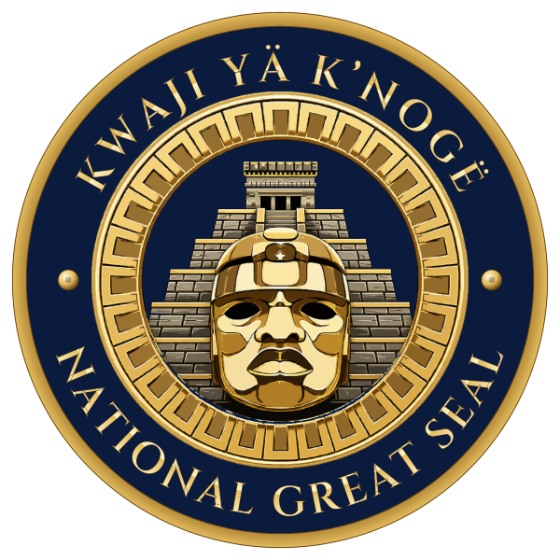
The Great Seal — stepped temple, ceremonial mask, and step-fret ring on a field of navy — authenticates every instrument of the Nation: the Charter, Trust reports, enrolment certificates, and Council decrees. Three ministerial seals share its die, distinguished only by accent and legend.
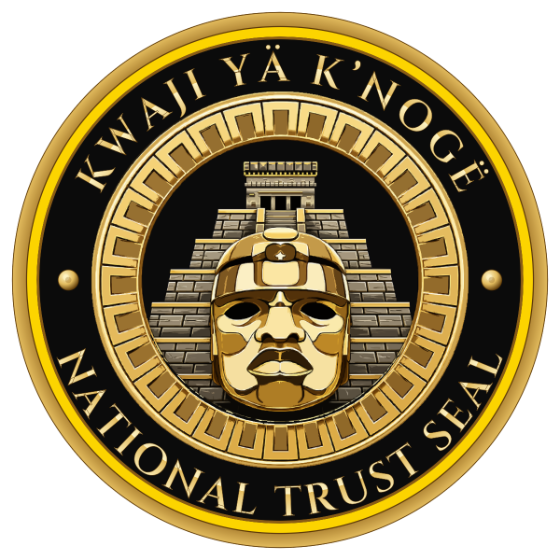
National Trust Seal
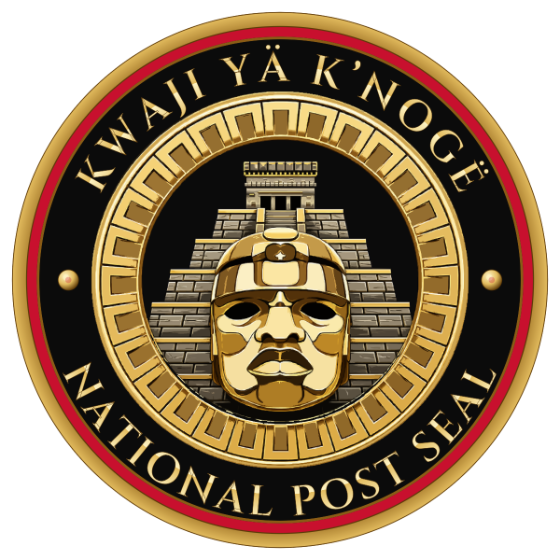
National Post Seal
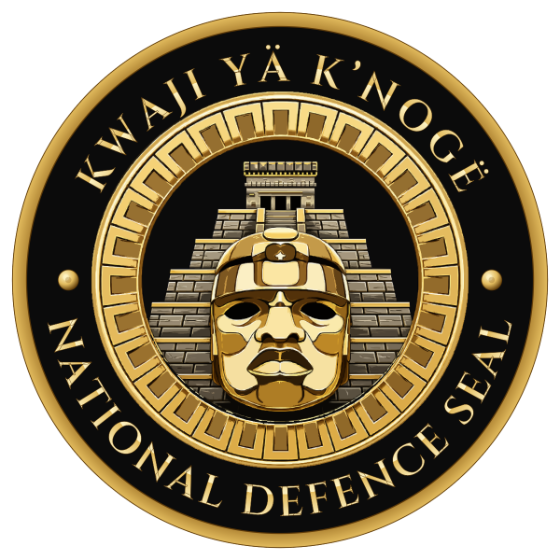
National Defence
Ministerial dies are struck from the Great Seal as master; Council approval is required before any seal enters use.
Preamble of the Constitution
“Banarema towa abunuhi” — people of the valley of dry bones.
We rise in remembrance, affirming that sovereignty is sacred, balance is eternal, and our covenant shall endure across generations.
Ceremonial Covenant & Sovereign Charter
The Constitution.
Fifteen articles enacted by the High Council in ceremonial assembly — read aloud three times before adoption, binding upon every ministry and consulate of the Nation.
Governance is guided by the sacred laws of Ma’at: truth, balance, order, harmony, reciprocity, and justice.
Article I
Sovereignty
Sovereignty flows from ancestral covenant and allodial title. No foreign power may annul or diminish it.
Article II
Membership
By birthright, adoption, or ceremonial oath. Maternal lineage grants automatic membership.
Article III
Governance
High Council, ministries, and consulates — guided by the sacred laws of Ma’at.
Article IV
The High Council
Elders and elected representatives interpret law and safeguard sovereignty in ceremonial assembly.
Article V
The Ministries
Five ministries answerable to the Council: Education, Health, Economy, Defence, and Ceremony.
Article VI
Judiciary
Independent of ministries. Three magistrates preside; bribery is charged as treason.
Article VII
Treason & Offences
Collusion, exploitation of land or people, desecration of sacred sites, corruption of office.
Article VIII
Currency & the Trust
A mineral-backed currency safeguarded by the Sanctum Tribal Trust under strict accountability.
Article IX
Education
Independent schools and trades colleges. Education is debt-free and mandatory for youth.
Article X
Holistic Health
Herbal medicine, ceremonial healing, and holistic care — debt-free and open to all members.
Article XI
Rights & Freedoms
Speech, ceremony, and assembly; education, health, and food security; protection from exploitation.
Article XII
Environmental Stewardship
Forests, rivers, mountains, and sacred sites are protected; desecration is treated as treason.
Article XIII
Land & Allodial Title
Ancestral lands are held in allodial and tribal freehold title, inalienable and held in trust for the generations.
Article XIV
National Symbols
The Flag and the Coat of Arms, the Totem Pole of Sovereign Animals, and the motto — Live True & Die Free.
Article XV
Seals of the Nation
The Great Seal as master die, and the ministerial seals of Trust, Post, and Defence struck from it under Council authority.
Current edition · amendments enter force only on Council resolution with Ministry Legal approval.
National Dossier · Bylaws of the Trust
The Sanctum Tribal Trust.
An irrevocable, non-grantor trust established by the Yánaru Hawahkan and the Council of Elders. Every article is recorded twice — once in formal legal text, once as ceremonial reflection. Read it in either voice.
Article II
Legal Status
An irrevocable, non-grantor trust operating exclusively under KWAJI:YÄ KNÖGÉ tribal law, customary law, and natural law — expressly excluding submission to foreign governmental authority.
Article III
Trustees
Trustees are appointed from among the Yánaru Hawahkan and senior council elders; they administer Trust property, authorise projects, and may be removed by majority vote of the Council.
Article IV
Beneficiaries
All enrolled members are beneficiaries, with access to sacred grounds, ceremonial participation, programmes, and voice in stewardship decisions.
Article V
Governance
The Council of Elders provides oversight and ceremonial affirmation. Disputes are resolved under tribal customary law with ceremonial mediation.
Article VI
Land & Resource Stewardship
All land is held in allodial freehold. No commercial activity may compromise sacred or ecological integrity; every project must preserve regenerative balance.
Article VII
Financial Management
Funds arise from donations, cultural commerce, and eco-tourism, allocated through the financial overlay system and reviewed annually in the Trust Ledger.
Article VIII
Digital & Intellectual Property
Bylaws, ceremonial texts, and digital assets are safeguarded by encryption, secure storage, and documented access protocols, recorded in the Tribal Ledger.
Article X
Dissolution
Dissolution requires unanimous consent of trustees and Council. All assets revert exclusively to the Nation; no external entity may claim any interest.
Articles I–X, Final Sovereignty Clause, and the Grounds Development Plan.
Sanctum Tribal Trust
The Trust Ledger: restricted.
The Ledger of the Sanctum Tribal Trust is not a public record. Its statements, balances, allowances, and scenario reports are held under fiduciary seal.
Access is granted to the High Council, the Trustees, and Enrolled Members in good standing, through the Member Portal.
“What the Trust holds, it holds for the lineage — and answers for it to the Council, not to the world.”