Ministry of Legal Affairs · Official Sovereign Portal Member Portal ↗

Home  /  Workshops  /  Abaká Itîbo

Abaká Itîbo.
The house of life.

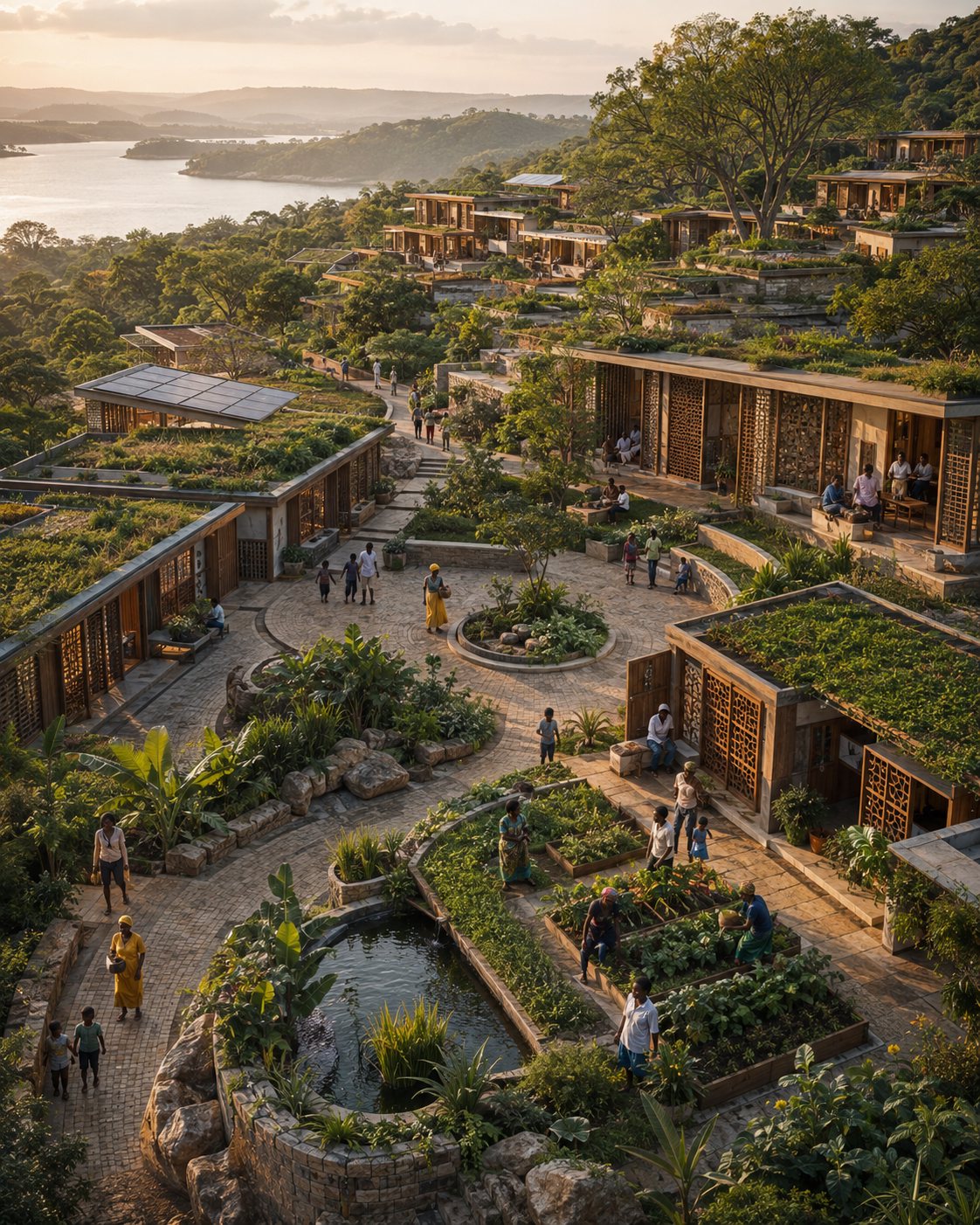
A 21-day immersion in carbon-negative regenerative dwelling. The form is a cluster of hand-cast hempcrete domes, Indigenous in geometry and Kiva-adjacent in spirit, refined for the Caribbean tropics. Hempcrete walls. Timber ring beams. Volcanic clay and lime finishing the skin.

Workshopiii. of vi.
Circle10 to 30 July
Seats12 in the circle
TuitionFrom $5,200
A Vincentian master craftswoman in her late forties on a Layher aluminum scaffold mid-tamp of fresh hempcrete into plywood formwork shutters wrapped around the curved greenheart timber rib frame of a 32-foot sculptural cocoon-shaped dwelling on Saint Vincent at late golden hour: refined navy cotton tunic under a tan canvas-and-leather work apron with hand-inlaid wood marquetry panel, contemporary leather-strap watch, modern leather work gloves, a heavy hardwood hempcrete tamper in her hands; her apprentice at the base lifting a modern PVC mortar pan of fresh hempcrete from a cordless paddle mixer; the cocoon's timber rib frame visible at the upper portion; a finished satellite cocoon glowing warm through its open threshold at right.
A senior Vincentian KWAJI:YÄ K'NÖGÉ master builder in his late fifties at the open-air planning platform at the elevated edge of the active cocoon cluster build at late golden hour: locs with grey threading, salt-and-pepper beard, dark olive cotton work shirt with sleeves rolled, charcoal canvas work pants, reading glasses on a leather cord, contemporary leather-strap watch, an architect's pencil over a large architectural elevation drawing of the cocoon dwelling unfurled across a trestle drafting table with a topographic site plan beneath and a tablet showing a 3D CAD model at the far edge; behind him, cocoons at varied stages of construction with Layher aluminum scaffolding and the build cohort visible at work, mature breadfruit canopy framing the platform.
The master builders

A guild, not a workshop.

The lead instructors of Abaká Itîbo are master builders of the KWAJI:YÄ K'NÖGÉ Nation, trained over decades in cast-hempcrete dome construction, mortise-and-tenon hardwood ring framing, hand-troweled clay and lime finishing, and the sacred geometry our ancestors gave the dwelling.

By week three, your hands will mix and cast hempcrete by feel, set a timber ring beam without metal where the geometry permits, trowel a lime-and-clay skin, and read a dome's structural logic from its plans.

The promise

A dwelling that breathes with the land.

By the third week you will have helped raise a guest dome that will host future fellows: a timber ring beam pegged into stone, a hempcrete shell hand-cast around curved formwork, a hand-troweled volcanic clay skin sealed in lime. The dwelling carries your name into the threshold. This is what we mean by covenant.

Hempcrete leads the curriculum because it is the most regenerative wall available to us: it locks carbon into the structure for the life of the building, it tolerates the tropical humidity without rotting or moulding, it resists fire and termites without chemistry, and it can be cast by hand on site by the cohort itself. The dome geometry, drawn from the Indigenous Caribbean reading of Kiva form, lets the hempcrete carry its own weight.

Hands-on building in tropical heat. We send a preparation guide and packing list on confirmation. Reasonable physical health is necessary.

The finished cocoon guest dwelling on the KWAJI:YÄ K'NÖGÉ ancestral land of Saint Vincent at late golden hour: the open arched threshold framed in finished greenheart timber with the timber ring beam pegged into stone visible at the threshold's lower edge with wooden pegs in the joint, a hand-inlaid wood marquetry lintel above the threshold inscribed with a fellow's name in greenheart-on-mahogany contrast, the curved hempcrete shell with hand-troweled volcanic clay-and-lime skin, warm 2700K interior glow through the threshold, mature breadfruit canopy framing the cocoon, a soft glimpse of a satellite cocoon at the deep edge.
The four bodies of a dwelling

Hempcrete. Timber. Clay and lime. Geometry.

Hempcrete is the body of the wall and the dome. Timber is the ring that carries it. Clay and lime are the breathing skin. Geometry is the grammar that organises the three.

Material i. The primary.The body

Hempcrete.
The body and the dome.

Hemp hurds, hydraulic lime, water. Cast by hand into curved formwork around a timber ring. Carbon-negative, breathable, pest-proof, fire-resistant, mould-resistant. The shell that locks atmospheric carbon into the dwelling for centuries.

Material iiThe ring

Timber.
The ring.

Greenheart and mahogany, milled by hand, mortise-and-tenon joinery, pegged. The ring beam that carries the dome and the threshold posts that anchor the entry.

Material iiiThe skin

Clay and lime.
The skin.

Hand-troweled volcanic clay base, lime wash for the breathing exterior, beeswax-and-tallow seal for the thresholds. The finish that lets the dwelling weather.

Material ivThe grammar

Geometry.
The grammar.

The proportions our ancestors gave a dwelling so it would breathe with the land it stands on. The Caribbean reading of Kiva geometry that organises hempcrete, timber, clay, and lime into a single regenerative whole.

Three weeks

Foundations. Truth. Return.

Week 1

Foundations.

Arrival ceremony. Indigenous housing forms across the Caribbean and the Kiva geometry that shapes our dome. Site preparation and stone foundations. Timber ring and threshold-beam joinery. Building the curved formwork that gives the dome its line.

Week 2

Walking in truth.

Hempcrete week. Mixing hemp hurds with hydraulic lime and water. Hand-casting the dome shell into the curved formwork. Curing. The science of a carbon-negative wall: hygroscopy, thermal mass, biogenic carbon storage. Storykeeping and language alongside.

Week 3

Covenant of return.

Striking the formwork. Hand-troweled volcanic clay base. Lime washing the breathing exterior. Hardware fitting: brass, bone, hand-forged iron. Visioning circle. Closing ceremony. Covenant signing: your name carved into the threshold of the dwelling you helped build.

The closing-ceremony covenant-carving moment at the finished cocoon guest dwelling on the KWAJI:YÄ K'NÖGÉ ancestral land of Saint Vincent at late golden hour: the lead fellow of the cohort kneeling at the threshold step mid-strike with a brass-ferruled greenheart-handle mortise chisel, carving the final glyph of the cohort's covenant inscription into the hand-inlaid wood marquetry lintel above the open arched threshold (a refined KWAJI:YÄ K'NÖGÉ Nation geometric glyph-set in greenheart-on-mahogany contrast), the senior Vincentian master builder standing beside in his dark-olive work shirt and reading-glasses cord gently steadying the chisel hand, witnessing cohort fellows in varied brand-palette closing-ceremony wardrobe gathered in a relaxed semi-circle at the threshold step, the cocoon's curved hempcrete shell with hand-troweled volcanic clay-and-lime skin rising above, the timber ring beam pegged into stone foundation visible at the threshold base, hand-forged iron strap hinges and brass-and-bone pull hardware on the threshold framing, warm 2700K interior glow through the open threshold.
The covenant-carving moment at Fountain Villa. Three weeks, one threshold. Stone foundation, timber ring, hempcrete shell, hand-troweled clay-and-lime skin, hand-forged hardware, the cohort's covenant glyph chiseled into the inlaid lintel by the fellow's own hand.
Carved into the threshold

Your name on the house.

The closing rite carves each fellow's nameplate into the dome's threshold beam. You leave with the building drawings, a hardwood off-cut from the build, and a continuing right to stay in the chapter dome for one week per year.

A close-up macro detail of the hand-inlaid wood marquetry nameplate set into the cocoon dwelling's greenheart timber threshold beam at late golden hour: a refined KWAJI:YÄ K'NÖGÉ Nation geometric glyph-set in greenheart-on-mahogany contrast marquetry, the wood grain of both species visible, a refined brass strap hinge at the upper edge of the beam, the cocoon's hand-troweled volcanic clay-and-lime exterior skin softening at the edges, a glimpse of the warm 2700K interior glow through the open threshold.
i. Mixing. Two cohort fellows at the hempcrete mixing station on the active build pad at warm morning daylight: cordless paddle mixer mid-spin over a mortar pan of fresh hempcrete, a kraft paper sack of hemp hurds tipping into the pan, lime dust rising in the morning light, varied work shirts (navy + olive), modern PPE.
ii. Casting. A cohort fellow on a Layher aluminum scaffold mid-tamp of fresh hempcrete into the marine-grade plywood formwork shutter wrapped around the curved greenheart timber rib frame of the cocoon dwelling: terra-rust work shirt, brass-ferruled hardwood hempcrete tamper, partner fellow's mortar pan glimpsed below.
iii. Finishing. A cohort fellow at the cocoon's curved exterior wall mid-trowel of fresh volcanic clay-and-lime finish onto the cured hempcrete shell: cream linen-cotton work shirt with sleeves rolled, braids gathered up with a cream linen scarf wrap, steel finishing trowel with hardwood handle, wood hawk loaded with fresh mix, the diagonal seam between freshly-applied finish and bare hempcrete cutting across the frame.
Tuition

From
$5,200 USD.

$800 deposit reserves your seat. Final payment due 60 days before arrival. Smaller circle of 12 for hands-on building.

Tuition includes
  • Single-occupancy lodgingIncluded
  • Three meals daily from the gardensIncluded
  • All instruction, tools, and building materialsIncluded
  • Transfers from Argyle International Airport (SVD)Included
  • Your name carved into the dome thresholdIncluded